
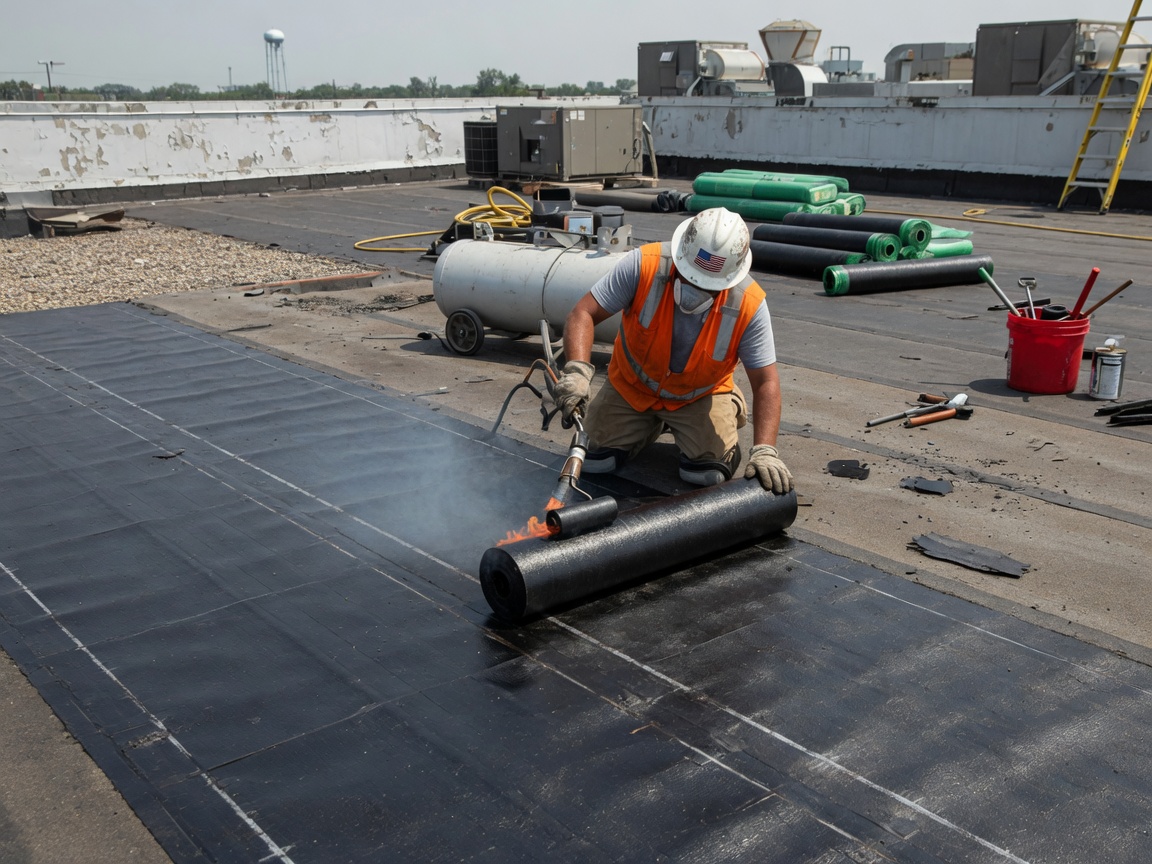
Lakewood's commercial roofs are mostly flat or low-slope, sitting on retail strips, offices and light industrial buildings along Clark Avenue, Del Amo Boulevard and around Lakewood Center. They fail differently from residential roofs. A sloped roof sheds water past a marginal detail in seconds. A flat roof holds that water over the same detail for days after a winter storm, which is why almost every commercial leak we trace comes back to ponding, a seam or a penetration rather than the membrane itself giving out.
The most important step on any commercial job is core sampling, and it happens before anyone quotes. We cut small test sections through the roof assembly to see whether the insulation under the membrane is dry. If it is, a restoration coating at $4 to $7 per square foot buys 10 to 15 more years. If the cores come back saturated, coating over it traps the water against the deck and you pay for the job twice. Any contractor quoting a commercial roof off a walkover alone is guessing.
Ponding is the local pattern. Many Lakewood buildings put up in the 1980s and 1990s have lost their original slope through deck deflection, and water now stands in the same low spots every winter. Replacing the membrane without addressing that just resets the clock on the same failure. Tapered insulation rebuilds positive drainage to the drains, and it is the line item owners most often try to cut and most often regret.
HVAC curbs, skylights and rooftop unit access are the second pattern. Every penetration is a potential leak, and every service technician walking the same route to a rooftop unit compresses the insulation along that path until the membrane splits. Walkway pads cost very little installed during a replacement and prevent a failure that is expensive and annoying to find later.
New systems have to meet current Los Angeles County energy code requirements for cool roofs, which for low-slope commercial work generally means a reflective membrane meeting minimum solar reflectance and thermal emittance values. TPO is the common answer because its reflectance is high out of the box. EPDM suits buildings with heavy foot traffic or a lot of mechanical equipment. We confirm what your building and scope actually trigger rather than assuming.
Replacement work in Mayfair, Lakewood Village and the retail corridors requires real coordination with property managers. We tear off in sections so no area is left open overnight, stage materials clear of tenant entrances, and flag hot work or odor-producing systems ahead of time for tenants with food service or sensitive stock.
Technician insight
In Lakewood the thing that catches most owners out with commercial roofing is how fast ponding develops on older flat roofs around Lakewood Plaza once the original slope is lost to deck deflection. Owners skip tapered insulation during replacement to save money, then fight the same leaks every winter in the same low spots. The tapered package is usually 10 to 15 percent of the job and it is the part that decides whether the new roof lasts 25 years or 12.
Retail Strip Roof Replacement Near Lakewood Center
A Mayfair retail center showed repeated interior leaks into two tenant spaces after heavy winter rain. Core samples came back saturated across roughly 40 percent of the 25 year old built-up roof, which ruled out a coating. We removed the old system, installed tapered polyiso to rebuild slope toward the existing drains, welded down a new TPO membrane with reinforced edge details, and added walkway pads along the route technicians were using to reach the rooftop units. Tear-off ran in four sections so no tenant lost trading days. No further leaks through the following rainy season.
Commercial Roofing Services We Offer
✓TPO Membrane Installation
Heat-welded TPO systems installed on flat commercial roofs in Lakewood to reflect heat, meet cool roof requirements and resist ponding.
✓EPDM Roof Replacement
Full removal and replacement of aging EPDM on retail and office buildings in Lakewood Village and Mayfair with new seams and flashings rated for local wind loads.
✓Built-Up Roofing Restoration
Coating systems applied over sound gravel-surfaced built-up roofs in Lakewood Gardens to add 10 to 15 years at roughly half the cost of replacement.
✓Tapered Insulation and Drainage Correction
Tapered polyiso packages that rebuild positive drainage on roofs where deck deflection has killed the original slope and created standing water.
✓Commercial Roof Inspection
Core sampling and infrared moisture scans for businesses in Lakewood Plaza and nearby Bellflower to find saturated insulation before it reaches tenant spaces.
✓Parapet and Edge Flashing Repair
Reinforcement of parapet walls and edge details on flat roofs, the second most common leak source after ponding, ahead of winter rains.
Commercial Roofing Cost in Lakewood, CA
| Service | Typical Range | What Affects It |
|---|---|---|
| Commercial roof inspection and core sampling | $250–$600 | Varies with square footage and access needs |
| TPO or EPDM full replacement | $8–$14 per sq ft | Per sq ft, includes insulation and flashings; higher for multi-layer tear-off |
| Built-up roof restoration coating | $4–$7 per sq ft | Per sq ft, over a sound existing roof; depends on surface prep required |
| Tapered insulation package | $2–$4 per sq ft | Per sq ft, rebuilds positive drainage where slope has been lost |
| Parapet flashing upgrade | $1,200–$3,500 | Per elevation; price moves with height and reinforcement needs |
| Walkway pad installation | $12–$20 per lin ft | Per linear foot along HVAC service routes |
Ranges are typical for Lakewood, CA and confirmed with an exact written quote before any work starts.
How it works
- 1
Site Assessment
We inspect the roof, deck condition and drainage, map the ponding areas, and document any Los Angeles County code issues that the scope will trigger.
- 2
Core Sampling and Moisture Survey
Test cuts through the assembly show whether the insulation is dry. This determines whether you are looking at a restoration coating or a full replacement, and it happens before any number is quoted.
- 3
System Selection
We recommend TPO, EPDM or modified bitumen matched to roof slope, building use and foot traffic, and confirm which cool roof requirements apply to your scope.
- 4
Preparation and Tear-Off
Existing roofing is removed in sections, deck repairs completed, and tapered insulation installed to rebuild drainage before the new membrane goes down.
- 5
Installation and Final Inspection
Membrane installed with heat-welded seams, all perimeter and penetration flashings renewed, walkway pads set along service routes, then a flood or leak test and walkthrough with the property manager.
Pricing
Commercial roofing costs depend on roof size, the condition of the insulation underneath and the membrane selected. On-site estimates with core sampling provided during business hours.